November 17, 2026
The Strait of Hormuz has once again become a major focus of international attention after fresh attacks on commercial oil tankers raised concerns about maritime security and the stability of global energy supplies. The latest incidents have increased fears that the ongoing tensions between the United States and Iran could create further disruption to one of the world’s most important shipping routes.
According to reports published on November 17, multiple tanker incidents were reported around the strategic waterway. The developments have also drawn attention to energy infrastructure in neighbouring countries, highlighting how regional instability can affect international trade, fuel markets and economic security.
What Happened in the Strait of Hormuz?
Reports from the United Kingdom Maritime Trade Operations agency described two tanker attacks in the Strait of Hormuz on Monday.
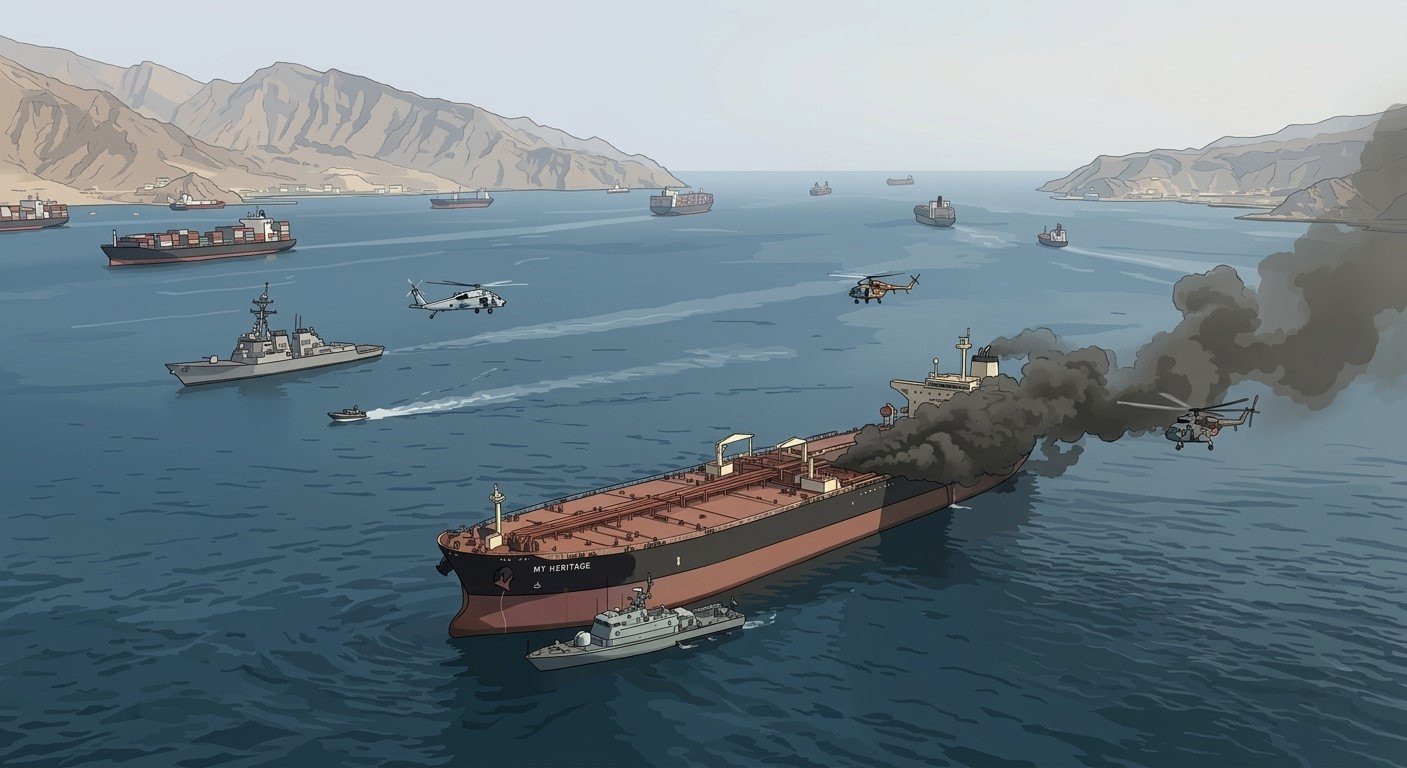
In one incident, a tanker was disabled and an engine-room fire broke out following an attack approximately seven nautical miles north of Khasab, Oman. In another incident, a commercial vessel was reportedly struck by an unidentified projectile while travelling out of the strait, also causing an engine-room fire.
No casualties were reported in the earlier incident, according to the maritime monitoring information cited by Al Jazeera.
Iranian military authorities separately claimed that oil tankers had struck naval mines and caught fire in restricted waters. However, those particular claims could not be independently verified, and the authorities did not identify the vessels involved.
It is therefore important to distinguish between incidents reported by maritime monitoring agencies and claims made by military authorities. The precise circumstances surrounding all reported attacks remain unclear.
Why Is the Strait of Hormuz So Important?

The Strait of Hormuz is a narrow maritime passage connecting the Persian Gulf with the Gulf of Oman and the wider Arabian Sea.
Despite its relatively limited geographical size, it plays an enormous role in international energy transportation. Oil and petroleum products from major Gulf producers travel through this route to reach international markets, including countries in Asia and beyond.
Any serious disruption to shipping through the strait can affect the movement of energy supplies and create uncertainty for businesses, governments and consumers.
Countries that depend heavily on imported energy may become particularly vulnerable when shipping routes face security threats.
For this reason, the safety of commercial vessels passing through the Strait of Hormuz is not simply a regional concern. It is an international economic issue.
Rising Tensions Between the United States and Iran
The latest tanker incidents have occurred against the backdrop of continuing tensions between Washington and Tehran.
According to Al Jazeera, the United States has reinforced its military presence in the region, with the aircraft carrier USS Theodore Roosevelt arriving in the area. A US official confirmed its arrival, bringing the number of American aircraft carriers operating within the US Central Command area to three.
At the same time, diplomatic efforts aimed at ending the conflict and reopening the strategic waterway have remained difficult.
The situation creates a complicated security environment. Military activity, commercial shipping concerns and diplomatic negotiations are developing simultaneously, making the region particularly sensitive to further incidents.
However, the available reports do not establish who was responsible for every tanker attack. Any attribution should be treated cautiously until supported by independently verified evidence.
Global Oil Prices and Economic Concerns
The security of the Strait of Hormuz is closely connected to the international energy market.
When shipping routes become dangerous, companies may face higher insurance costs, delays, additional security requirements and uncertainty about delivery schedules.
These factors can influence the overall cost of transporting oil and other goods.
Reuters reported on November 17 that Gulf stock markets were mixed as investors assessed tanker attacks and efforts to protect regional shipping routes.
Brent crude futures were reported at $91.62 per barrel, down 0.9% in early trading. This illustrates an important point: geopolitical tensions do not automatically cause oil prices to rise. Market expectations about supply, demand and future exports also play a significant role.
If shipping disruptions become more severe or last longer, however, energy markets could face additional uncertainty.
For ordinary households, sustained increases in international energy costs can eventually affect transport expenses, electricity generation, industrial production and the prices of everyday goods.
Why Pakistan Should Pay Attention
Developments in the Strait of Hormuz are particularly relevant to Pakistan because the country relies on imported energy to meet a substantial part of its requirements.
Disruptions to Gulf shipping could create challenges for the timely delivery and cost of imported petroleum products and other energy supplies.
Higher international oil prices can also increase pressure on Pakistan’s import bill, potentially affecting the country’s foreign exchange requirements and domestic fuel prices.
The impact would depend on the duration and scale of any disruption, international market conditions, available supplies and government policy decisions.
For Pakistan, maintaining reliable energy imports and monitoring developments in the Gulf region remain important economic priorities.
Other Asian economies that depend on energy transported through the region could also face similar concerns.
Another Warning About Regional Energy Security
The latest developments have not been limited to commercial vessels.
Al Jazeera also reported a drone alert near the Khor Mor gas field in Iraq’s semi-autonomous Kurdistan region. Warning sirens sounded after a drone flew over the facility, although there were no immediate reports of a strike or damage during that incident.
Production at the gas field had already been halted the previous week following a suspected drone attack that caused a fire and disrupted electricity generation.
The incident demonstrates how threats to energy infrastructure can extend beyond oil tankers and maritime transportation.
Modern economies depend on interconnected systems involving oil production, gas facilities, power stations, pipelines and shipping networks. Damage or disruption to one part of this system can create wider consequences.
What Could Happen Next?
The future of commercial shipping through the Strait of Hormuz will depend on several factors, including regional security arrangements, diplomatic negotiations and the ability of maritime authorities to protect vessels.
A reduction in tensions could help restore confidence among shipping companies and energy traders. Further attacks, however, could increase uncertainty and place additional pressure on international trade.
Governments and shipping operators will likely continue monitoring the situation closely.
For now, the most important questions remain unanswered: How many vessels will be affected by further incidents? Will diplomatic efforts reduce tensions? And how long will commercial shipping face heightened security risks?
Conclusion
The latest tanker attacks in the Strait of Hormuz are a reminder of how events in one strategic waterway can influence economies across the world.
From international oil markets to Pakistan’s energy import costs, the consequences of prolonged shipping disruption could extend far beyond the Middle East.
Although the full circumstances of the reported incidents are still being established, the importance of maritime security and stable international trade routes has rarely been clearer.
The coming days will be crucial in determining whether diplomatic efforts can ease tensions or whether shipping companies and energy markets will face further uncertainty.
About the Author