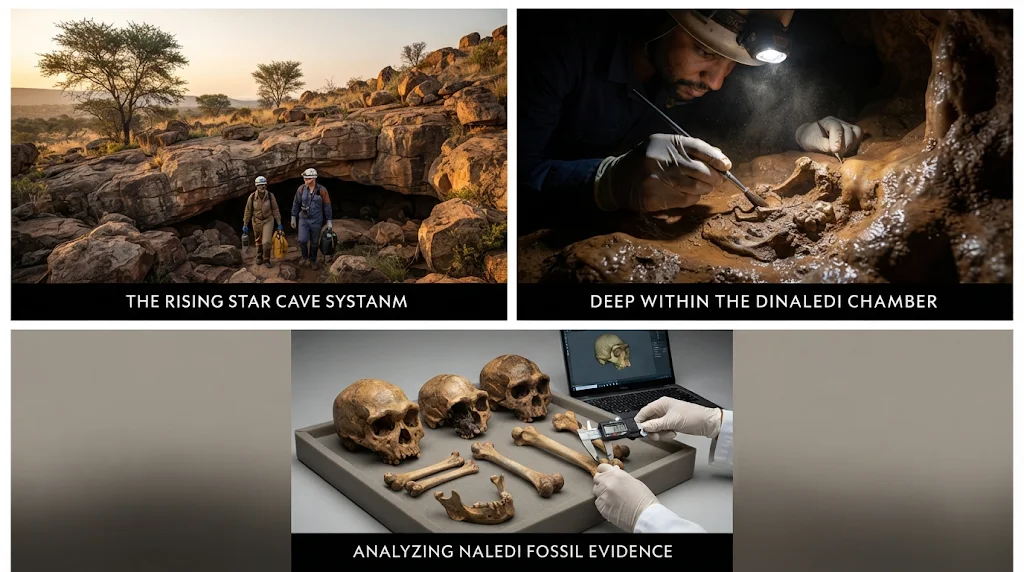
A mysterious discovery in a South African cave has raised one of the strangest questions about our ancient relatives: Why have scientists found no evidence of males among the fossils they examined?
Deep beneath the ground in South Africa, researchers have uncovered an extraordinary mystery involving an extinct human relative known as Homo naledi.
These ancient creatures lived approximately 335,000 to 241,000 years ago. Their fossils were discovered inside the Rising Star Cave system, where scientists have been investigating their unusual remains for more than a decade.
But a recent scientific investigation has revealed something unexpected.
Researchers examined ancient proteins preserved inside fossilized teeth belonging to at least 20 individuals. Surprisingly, they found no evidence of a protein marker normally associated with biological males.
The discovery has raised questions about the lives, social behavior and possible burial practices of this mysterious ancient species.
The Mystery Hidden Inside Ancient Teeth
For years, scientists have wondered why the adult Homo naledi fossils discovered in parts of the cave appeared remarkably similar.
Normally, researchers expect to find certain physical differences between male and female individuals.
However, the fossils showed surprisingly little variation.
To investigate this mystery, an international team of scientists used a special technique to extract tiny fragments of ancient proteins from fossilized tooth enamel.
They examined 23 teeth representing at least 20 individuals.
Their main target was a protein called amelogenin-Y, which is normally associated with the male Y chromosome.
The results were surprising.
None of the examined individuals showed convincing evidence of this male-specific marker.
Could This Have Been an Ancient All-Female Burial Site?
One possible explanation is that the cave contained the remains of an exclusively female group.
If that interpretation is correct, it could reveal unusual social or cultural behavior among Homo naledi.
Some researchers have suggested that the remains might provide clues about ancient burial practices in which individuals of one sex were treated differently after death.
However, scientists have not established that this was actually a burial site reserved for females.
There is another possible explanation.
Researchers cannot completely rule out the possibility that the gene responsible for producing the male-specific protein was altered or missing in this ancient population.
That means some individuals could have been biologically male even though the expected protein marker was absent.
A Discovery That Could Change Our Understanding of Ancient Humans
The discovery is important because it demonstrates how scientists can investigate ancient human relatives using proteins preserved in fossilized teeth.
Unlike some other biological materials, tooth enamel can protect ancient proteins from environmental damage for extraordinarily long periods.
This gives researchers an opportunity to investigate the biology of creatures that disappeared hundreds of thousands of years ago.
The research was published in the scientific journal Cell, with the findings attracting renewed attention in November 2026.
The Biggest Question Remains
Were these ancient individuals really all female?
Did Homo naledi have unusual social traditions that influenced how their dead were placed in caves?
Or is there a hidden genetic explanation that scientists have not yet discovered?
For now, researchers do not have a final answer.
One thing is certain: a few tiny proteins preserved inside ancient teeth have opened a fascinating new chapter in the mystery of human evolution.
What do you think? Could this cave really have been an ancient all-female burial site, or is there another explanation waiting to be discovered?
About the Author